


Urban transport, metro and tram
Metro and trams
The metro is almost always considered to be the cornerstone of integrated urban transport systems.
Travelling speed, high transport capacity in terms of passenger volume and low environmental impact are the main reasons behind a rapidly expanding market, even in countries where this sector has traditionally not seen significant investments.
At the same time, traffic congestion in major cities encourages the development of important projects to create or upgrade fast light-duty rail systems, as well as tram networks and especially trolley-bus/tram systems characterised by greater manoeuvring flexibility in urban congestion.
Our experience
GCF S.p.A. has transferred into these segments all the experience gained over the years in construction, maintenance, electrification and signalling sites for the main sector players in Italy: ATM (Azienda Trasporti Milanese), GTT (Gruppo Torinese Trasporti), ATAC (Azienda per il Trasporto Autoferrotramviario) e Metro Roma.
International projects
In recent years, important development projects in France and Denmark have seen GCF S.p.A. as a reliable provider and partner thanks to its organisational and operational skills as well as its machinery and equipment capable of ensuring fast, high quality execution.
Our competitive edge
The specific nature of metro and tram sites is extremely variable, thereby requiring special operating models capable of coping with and solving several typical critical aspects:
- opening of sites in city centres;
- logistic procurement and handling of machinery in the heart of the city;
- underground work in tunnels, often at considerable depths;
- the need to observe stringent environmental criteria to minimise noise, dust and vibration.
GCF S.p.A. operates with highly qualified personnel having specific training in relation to the characteristic features of each individual site. It also uses “light-duty” machinery capable of combining site performance with respect for environmental conditions necessary in city centres and project timing.
Some GCF and Group Companies construction sites


Toulouse Metro Line B Extension - France
Project to extend Line B of the Toulouse Metro from Ramonville station for 2.7 km eastwards, with an initial underground tunnel section and, after crossing the Canal du Midi, a second section on viaduct connecting the two new elevated stations of Parc Technologique du Canal (PTC) and Institut Polytechnique ligne B (IPB).
GCF S.p.A.’s works, initiated in February 2025, consist in the construction of the track system including the reinforced concrete track slab, running surfaces and lateral guide bars (3,230 metres of single track on viaduct and 1,020 metres of single track for the underground connection to the existing line), the installation of three turnouts, as well as the supply and installation of evacuation walkways located alongside each track.


Reconstruction of the Milan–Limbiate Extra-Urban Tramway, Italy
Redevelopment project of the “Frecciarancio” line in the Comasina district, on the northern outskirts of Milan.
Milano MM S.p.A. (Metropolitana Milanese) plans the complete demolition of the current single-track line running adjacent to the road, in order to fully redesign the alignment and allow, wherever possible, the relocation of the track onto a dedicated right-of-way positioned in the centre of the roadway between the two carriageways.
In addition to trackwork and electric traction works, the project includes the complete renewal of the line’s technological systems, interventions on station platforms, and complementary civil works on roads, cycle paths and pedestrian crossings.


Saint-Denis - Porte de Paris T8 Tram Line
With its two branches, tramway Line T8 connects Saint-Denis – Porte de Paris with Épinay-sur-Seine and the university district of Villetaneuse to the north, and links southwards with the M13 metro line in Paris.
The trackwork project, commissioned by RATP, was carried out by GCF S.p.A. in consortium with Esaf and Laforet.
Generale Costruzioni Ferroviarie was specifically responsible for the installation of approximately 18 kilometres of track and turnouts, previously treated with anti-wear and anti-squeal protection.


Tram Line T2 Bergamo - Villa d’Almè, Italy
The new T2 Bergamo - Villa d’Almè tramway line extends over 11.5 km along the former Valle Brembana railway alignment. The route, entirely double track on a dedicated right-of-way, crosses five municipalities and serves a population of over 240,000 inhabitants.
Within the consortium awarded the contract by TEB (Tramvie Elettriche Bergamasche), GCF S.p.A. is specifically responsible for the execution of trackworks, electric traction systems and the planned electrical substations, signalling systems and all project-related technical installations.

New Metro Line SIR 2 Padua - Eastern Section, Italy
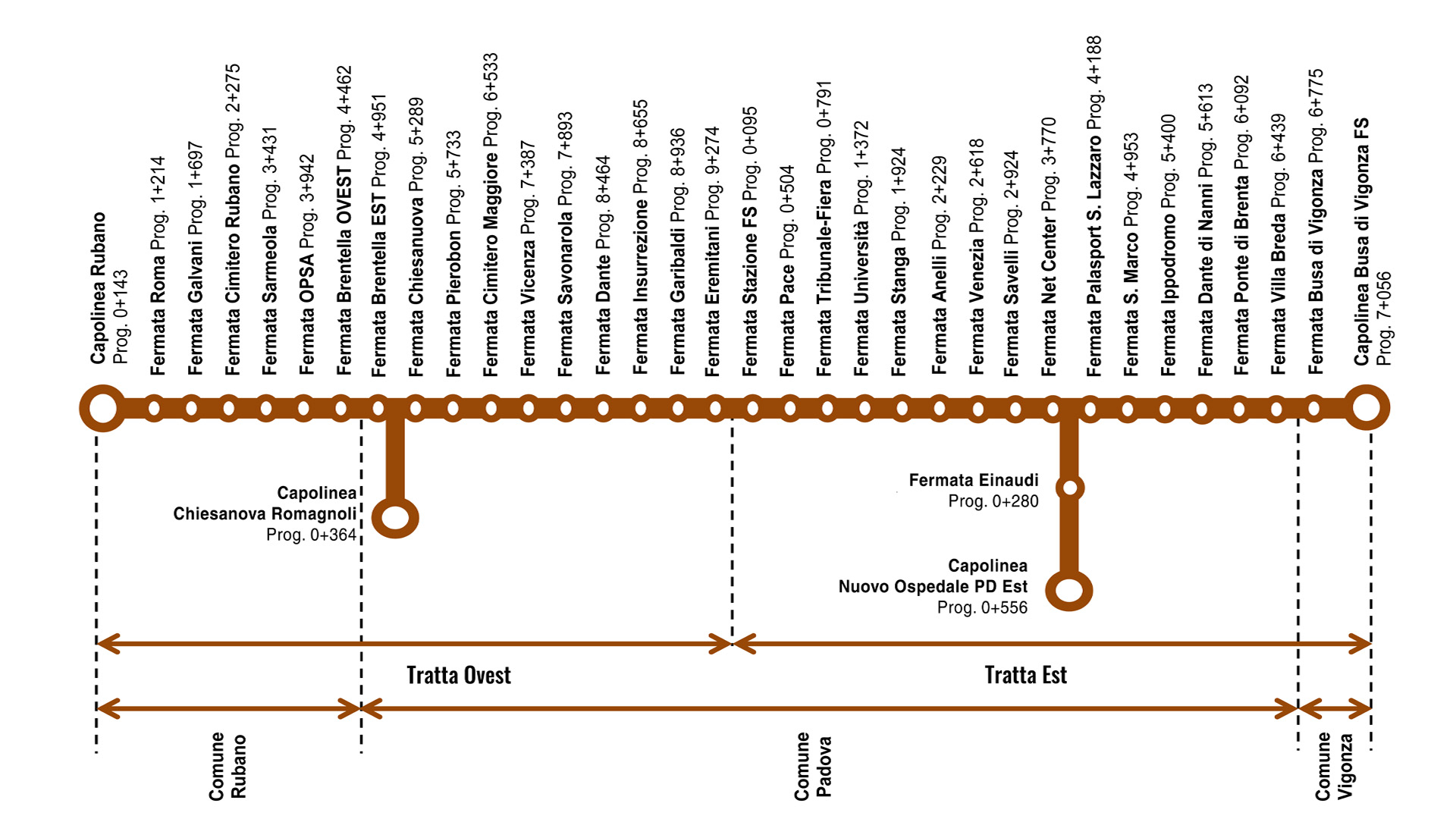
New tramway line along the east-west axis of the city of Padua. Like Line 1, Sir2 (Sistema Intermedio a Rete) adopts Translohr technology, with rubber-tyred trams that are more easily integrated into urban environments.
The East Section, awarded to the Vittadello - Sielte - GCF consortium, includes a route of approximately 7 km from Padua Station to Busa di Vigonza, with installation of the monorail and tramway infrastructure positioned in the centre of the roadway - an option adopted as the primary solution for 85% of the East section - in order to maximize the proportion of dedicated lanes.


Salerno Metro Extension, Italy
Construction of a 9 km single-track line, fully electrified, running alongside the existing double-track Salerno–Battipaglia line (odd track side), up to Salerno “Costa d’Amalfi” Airport.
Within the consortium awarded the contract, GCF S.p.A. is responsible for Trackwork, Electric Traction, Electrical Substations and Signalling works, as well as Power Supply (Light and Power), Mechanical systems and Telecommunications installations.

LEB Tramway, Lausanne, Switzerland
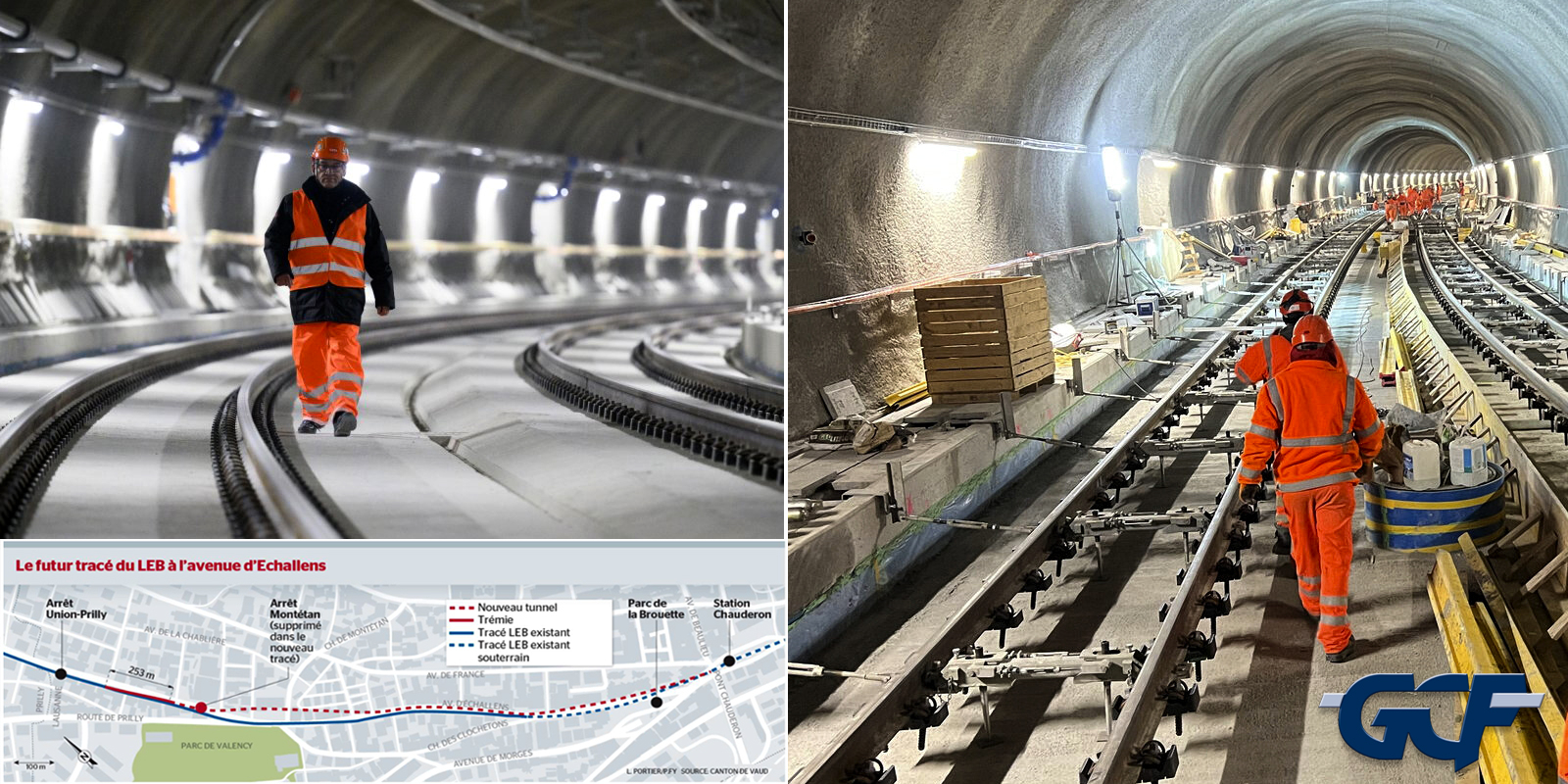
GCF S.p.A. carried out the supply and installation of track materials required for the new tunnel section and the simultaneous renewal of an additional section already located in tunnel, constructing a total of approximately 4 km of metre-gauge track on slab and 400 metres of metre-gauge track on ballast, as well as supplying and installing 10 turnouts. A rigid overhead contact line was also installed over approximately 4.2 km in tunnel, together with about 500 metres of flexible catenary at the tunnel entrances and exits to connect with the existing overhead line.


Milan Metro, Italy
On behalf of Astaldi S.p.A., GCF performed modification and renovation work on lines that were temporarily closed during the construction of Metro Line 5 Garibaldi - San Siro.
Also for Metropolitana di Milano (Commitente Metro Blu Scrl) Generale Costruzioni Ferroviarie SpA, he carried out the "modified Milan" type railway armament works for the "Expo section" of Line 4, the so-called "Blue Line" which connects the city from the east (Linate Airport terminus) to the southwest up to the terminus at San Cristoforo.


Copenhagen Metro, Denmark
As a specialist subcontractor to the Ansaldo Group, GCF S.p.A. participated in the construction of the main track and service track of the Cityringen Metro - Line M3 in Copenhagen.
A natural expansion of Line 1, the circular alignment runs through the city centre, entirely in twin-bore tunnel, over a length of 17.4 km – corresponding to 35 km of track - serving 17 new stations.
In addition to installing tracks on concrete slab, GCF also carried out the installation of the third rail used for electric power supply.


Aarhus, light rail, Denmark
In consortium with Ansaldo and Stadler, GCF participated in the construction of the first light rail line in Aarhus, Denmark’s second-largest city.
The project included the renewal and electrification of approximately 100 km of regional railway lines and their connection to 12 km of new double-track line serving Aarhus’ most densely populated areas: Aarhus Central Station, the university hospital complex and the urban development district.
A particularly significant project that delivered to the city a 110 km light rail network serving 51 stops.


Turin Metro, Italy
The first fully automated metro built in Italy. For the Turin Metro, GCF S.p.A. carried out the extension from Porta Nuova station to Lingotto Fiere, inaugurated in March 2011.
The section, entirely underground, follows an “undulating” alignment over a total length of 7,400 metres serving seven stations. The track was installed on a concrete slab using specialised machinery specifically developed for this type of rolling stock and infrastructure.
GCF construction sites were established near the shafts of several stations, within densely populated urban areas, requiring the management of significant logistical complexities, particularly regarding the supply of construction materials.